
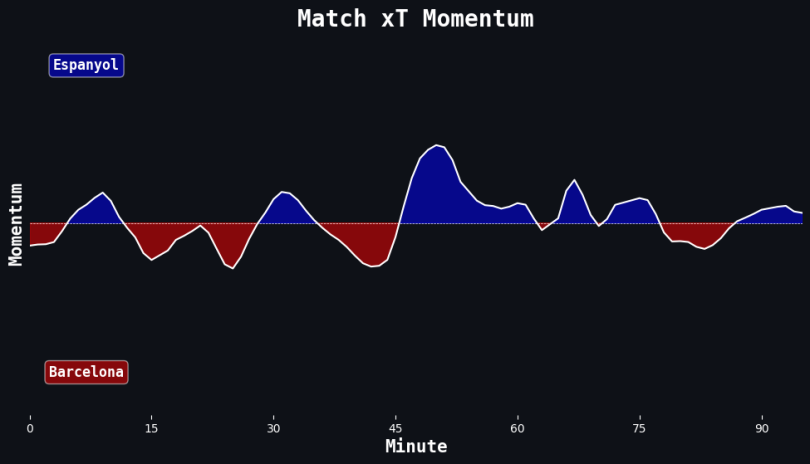

Momentum in Serie A is rarely accidental or purely emotional. It emerges from tactical adjustments, spatial control, and psychological responses to game events. Unlike leagues where tempo swings rapidly, Serie A momentum often builds gradually, then flips decisively once a structural threshold is crossed. Analyzing these shifts requires understanding not only who controls the ball, but who controls space, decision-making speed, and risk tolerance at different moments of the match.
Why momentum in Serie A develops differently than in other leagues
Serie A’s tactical culture emphasizes control over chaos. Teams are generally comfortable absorbing pressure for long periods if defensive spacing remains intact. The cause is tactical patience; the outcome is delayed momentum swings; the impact is matches that appear balanced before suddenly tilting. Momentum here is less about energy surges and more about cumulative positional advantage that eventually forces structural concessions.
Game-state triggers that initiate momentum swings
Momentum rarely changes without a trigger. In Serie A, these triggers are often subtle: a fullback pushed five meters higher, a midfielder stepping out earlier, or a forward beginning to press selectively. Once one team alters its risk profile, the opponent must respond, and momentum begins to shift. These changes often precede goals by several minutes, making them more predictive than the goal itself.
Teams frequently involved in momentum-heavy fixtures
Certain teams are structurally inclined to create or exploit momentum swings. Inter Milan often build pressure through sustained territorial dominance, while Atalanta generate momentum through aggressive man-oriented pressing. Napoli frequently control momentum via circulation speed and positional rotations. Each uses different tools, but all convert structural advantages into prolonged control phases.
How possession and territory interact with momentum
Possession alone does not define momentum in Serie A. A team may hold the ball without progressing territory, resulting in static control rather than momentum. True momentum appears when possession leads to repeated entries into threatening zones, forcing defensive adjustments. Once defenders retreat or overcommit, momentum solidifies, reducing the opponent’s ability to reset shape calmly.
Observable patterns that confirm momentum has shifted
Before momentum becomes obvious on the scoreboard, several on-field patterns usually emerge. These signals help distinguish temporary pressure from genuine control.
Common confirmation patterns include:
- Defensive lines retreating deeper with each phase
- Midfielders receiving under increasing pressure
- Clearance distance shortening over successive actions
- Fouls occurring closer to the defending penalty area
Interpreting these patterns together shows that momentum is spatial before it is numerical. The list highlights how pressure accumulates through field position rather than shot count. Once these indicators align, the likelihood of a decisive event rises sharply even if goals do not arrive immediately.
Momentum collapse and rapid reversals
Momentum in Serie A is fragile once disrupted. A single successful counterattack, tactical foul, or substitution can reset control instantly. Teams that rely heavily on one pressing mechanism often struggle to reassert momentum after disruption, while more flexible sides adapt and regain control within minutes. This explains why some matches feature multiple momentum swings rather than one continuous arc.
To clarify how momentum stability differs, the table below contrasts sustained versus unstable momentum phases.
| Momentum Type | Key Trait | Match Impact |
| Sustained | Structural control across zones | Gradual dominance |
| Fragile | Reliant on pressing intensity | Sudden reversals |
| Artificial | Driven by scoreline only | Short-lived pressure |
Reading the table shows that not all momentum carries equal predictive value. Structural momentum persists, while emotional or scoreline-driven momentum fades quickly once challenged.
Educational interpretation during live analysis
From an educational perspective, momentum analysis sharpens real-time reading of matches. Observers focusing on structure rather than events often detect momentum shifts earlier. During such analysis across a betting interface, references to ufa168 may appear when tracking how live pricing responds to territorial dominance rather than goals. The key insight is that momentum influences probability before it influences outcomes, making structural awareness more informative than scoreboard reactions.
Where momentum analysis tends to fail
Momentum analysis loses accuracy when matches are disrupted by red cards, injuries, or extreme weather. In these scenarios, structure dissolves unpredictably, and traditional momentum indicators lose reliability. Serie A matches with heavy officiating intervention often resist clear momentum narratives, as play becomes fragmented rather than progressive.
Conditional scenarios that distort momentum reading
Early goals can mask true momentum, especially when the scoring team immediately retreats and concedes territorial control despite leading.
Summary
Momentum in Serie A is a product of structural control, risk adjustment, and spatial pressure rather than raw intensity. It develops gradually, becomes visible through positional signals, and can collapse quickly when disrupted. Understanding these dynamics allows for clearer interpretation of match flow, highlighting why some teams dominate without scoring and why others strike decisively during brief momentum windows.