
The 2023/24 Premier League season ran from 11 August 2023 to 19 May 2024, delivering 380 matches and constant betting temptation across nine months. Without a structured pre‑match checklist, most decisions default to recency bias, emotions, or media narratives rather than a repeatable process.
Why every Premier League bet needs a fixed checklist
A fixed checklist forces the bettor to move step by step from information to judgement rather than jumping straight from “feeling” to stake size. In a league where fixtures are dense and results are volatile, standardising how you process team news, form, and odds reduces the chance that one surprising result triggers a series of impulsive follow‑up bets.
The 2023/24 calendar, with its festive congestion, mid‑season break in January, and occasional double gameweeks, made ad‑hoc analysis particularly risky because context changed quickly from week to week. By answering the same set of questions before every match, you anchor decisions in criteria you chose in advance, rather than in whatever storyline happens to be loudest that gameweek.
Step 1: Clarify the match context before any stats
Context has to come first because identical stats can mean different things depending on schedule, motivation, and competition stakes. For example, a mid‑table side on 40 points in April 2024 faced very different incentives compared with a relegation candidate fighting for survival, even if their basic form over the last five games looked similar.
In 2023/24, the league’s design ensured no two festive rounds were played within 48 hours of each other, yet many teams still played three matches in quick succession around Christmas and New Year. Your checklist therefore should start with questions about rest days, travel, and whether either team has just played in a cup competition or is looking ahead to a decisive fixture, because these factors shape rotation and intensity before you ever look at xG.
Step 2: Use a structured form and metrics review
Form and numbers matter, but they only add value when you force yourself to read them consistently across matches. A disciplined checklist avoids cherry‑picking by committing you to the same minimal dataset every time: recent results, home/away splits, and key performance metrics such as expected goals and defensive records.
In the 2023/24 Premier League, league tables and raw goal numbers could be quickly supplemented by advanced statistics from public databases that tracked shooting volume, xG, and conversion rates for all 20 teams. Checking those same fields before every bet makes it harder to overrate a short winning streak that rode on unsustainable finishing rather than on stable chance creation.
Core checklist items in list form
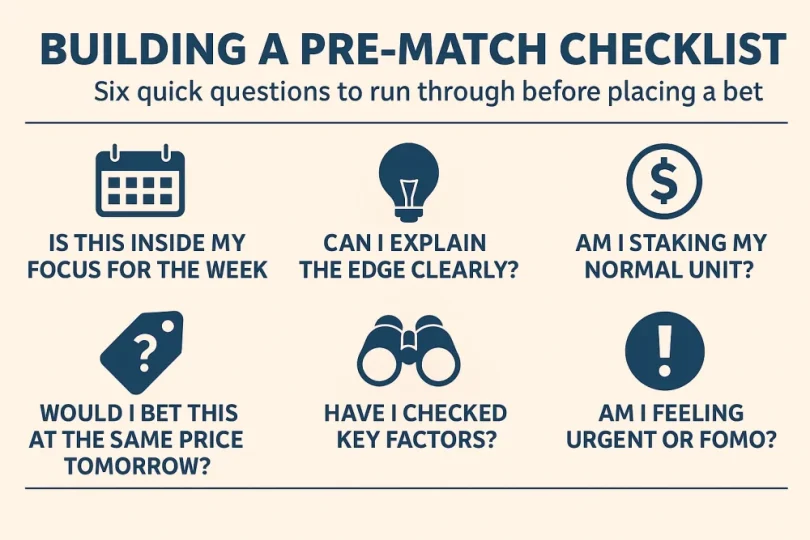
Before building a table of prompts, it helps to see the core components of a universal pre‑match routine in one continuous sequence. The goal is not to cover everything that might matter, but to secure a minimum standard: if any step fails, you either adjust the bet or skip the match. Each line in this list represents a simple yes/no or descriptive check you can repeat for every 2023/24 fixture without needing to reinvent your process.
- Confirm competition and timing: Premier League only, date and kick‑off time verified against the official 2023/24 schedule.
- Check rest and congestion: days since each team’s last match and whether they played midweek (league or cup).
- Review key team news: injuries, suspensions, and expected rotation in core roles (keeper, centre‑backs, primary creators).
- Assess recent performance: last five games in all competitions, with separate home/away splits and at least basic xG figures.
- Consider motivation and stakes: title race, European spots, safety, or relegation pressure relevant to this fixture.
- Compare your probability estimate with available odds to see if there is a clear edge rather than just a hunch.
- Cross‑check bankroll rules: stake size consistent with your plan, no chasing, and total exposure for the gameweek within limits.
Reading this list as a workflow rather than a menu is crucial: skipping steps only when they genuinely do not apply, and stopping the process when any answer exposes that you are leaning on emotion instead of information. Over time, the discipline of running through the same sequence before every 2023/24 match helps distinguish situations where you actually hold an informational advantage from those where you are simply reacting to short‑term form or media noise.
Step 3: Turn checklist items into a personal table you can reuse
A table format makes the checklist easier to apply because each match can be evaluated row by row, with short notes instead of long narratives. When you log your answers in the same structure for every 2023/24 game you bet on, patterns emerge about which checks you consistently respect and which you ignore when under pressure.
| Checklist dimension | Key question to answer before 2023/24 bets | Practical note for this matchday |
| Schedule & rest | How many days since each team’s last game? Midweek match involved? | |
| Team news | Any confirmed absences in core spine or creative roles? | |
| Recent form & xG | Are results supported by xG and chance quality, or just hot finishing? | |
| Tactical match‑up | High press vs deep block, direct vs possession—who dictates tempo? | |
| Motivation | Does either side have stronger incentives based on table position? | |
| Odds vs your probabilities | Does the offered price exceed your estimated fair odds by a clear margin? | |
| Bankroll & emotion | Is stake size within plan and free from tilt or “must win” thinking? |
The value of this table appears over time rather than in a single round; by filling it in honestly across multiple gameweeks, you create a record that shows whether losing bets were bad ideas from the start or simply normal variance. That distinction helps refine the checklist itself, nudging you to upgrade weak questions, drop redundant ones, and sharpen the ones that consistently correlate with profitable decisions.
Step 4: Integrate data sources without drowning in numbers
Modern bettors can access detailed Premier League statistics, from basic tables to advanced models that track expected goals and shot quality for every team and player. The danger is that without a clear plan, you end up scrolling through charts that confirm what you already believe, instead of testing your assumptions about a match.
A practical rule for the 2023/24 season was to pre‑decide which three to five metrics mattered most—such as team xG for and against, shots allowed, and home/away goal differences—and to check only those before every bet. Keeping the data layer narrowly defined prevented paralysis from too much information while still anchoring your checklist in measurable performance rather than in vague impressions.
Step 5: Using a betting platform history to refine the checklist
Over a full Premier League campaign, your own bet history can reveal more about your real behaviour than any theoretical plan. When that record is concentrated in a single online betting site, it becomes easier to connect specific decisions to the checklist items you did—or did not—respect at the time. By periodically exporting or reviewing your 2023/24 wagers from ufa168, you can tag each bet according to whether team news was confirmed, whether odds offered genuine value based on your probabilities, and whether stake sizes aligned with bankroll rules, then adjust the checklist to target recurring mistakes rather than abstract ideals.
Step 6: Keep the checklist separate from casino online impulses
A pre‑match checklist is designed for structured decisions in markets where information and analysis can shift probabilities, which is the case in football betting but not in all gambling contexts. Research on digital gambling shows that when bettors slide from sports into higher‑frequency products, emotional decision‑making often accelerates and risk controls weaken. If you apply rigorous checks to Premier League bets and then move straight into a casino online setting without any comparable framework, you effectively abandon the discipline you just built.
For the checklist to truly protect decision quality, it needs to define not only how you approach football matches but also when you stop risking money altogether. That might mean a rule that once your planned 2023/24 bets for a gameweek are placed, you do not seek additional “action” elsewhere, reinforcing the idea that preparation and selectivity—not constant wagering—drive long‑term sustainability.
Step 7: Where a checklist can fail and how to correct it
Even a well‑designed checklist can fail if it becomes a box‑ticking exercise rather than a genuine thinking tool. If you find that you are rushing through questions just to justify a bet you already want, the cause–effect chain reverses: emotion leads, and the checklist merely provides post‑hoc rationalisation. In that state, you will ignore warning signs such as poor rest, missing key players, or misaligned odds because the outcome you desire—having a bet on the match—comes first.
Another failure point arises when the checklist never evolves in response to evidence from the season. If certain items consistently fail to predict outcomes in 2023/24, or if new factors (like injuries to key systems players) prove crucial, then refusing to update your process turns yesterday’s strengths into today’s blind spots. Periodic reviews—perhaps during the January break or international windows—help ensure the checklist remains a living tool rather than a fixed ritual.
Summary
The 2023/24 Premier League season’s long, tightly scheduled campaign highlighted how easily bettors can drift into reactive decisions without a fixed pre‑match process. Building a personal checklist—covering context, team news, form, tactical match‑ups, odds, and bankroll controls—creates a repeatable framework that can be applied to every fixture, reducing the influence of noise and emotion.
When that checklist is grounded in consistent data sources, periodically audited against your own bet history, and kept clearly separate from impulse‑driven gambling in other environments, it becomes more than a routine; it functions as a practical safeguard for long‑term decision quality across an entire Premier League season.